



Fish Populations
Fish health, abundance, tissue quality, and habitat availability are linked to environmental conditions, and fish are therefore an important biological indicator of ecosystem health and integrity. Fish are also a highly-valued subsistence and recreational resource in the Athabasca oil sands region. The RAMP Fish Populations component monitors the health and sustainability of fish populations throughout the oil sands region using a variety of sampling and survey techniques.
The objectives of the RAMP Fish Populations component are to:
- Collect fish population data to characterize the natural variability in fish populations, assess predictions documented in EIAs, and meet monitoring requirements found in regulatory approvals.
- Monitor potential changes in fish populations resulting from stressors (physical, chemical, or biological) linked to oil sands developments, by assessing attributes such as growth, reproduction, and survival.
- Determine the suitability of fish in the oil sands region for human consumption.
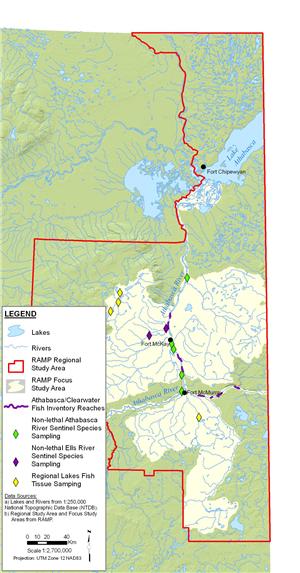
In an effort to address multiple issues related to fish populations, RAMP implements four different sampling programs on the Athabasca River and its tributaries, as follows:
Fish Inventories
Fish inventory studies are conducted by RAMP to examine trends in abundance and population variables for key indicator fish species, including walleye, northern pike, longnose sucker, white sucker, lake whitefish, goldeye, and trout perch. Inventories are generally conducted on larger rivers (e.g., the Athabasca and Clearwater) in three seasons each year to account for the different species’ life histories. Fish are temporarily stunned using an electrofishing boat, captured with dip nets, and held on board for counting, measurement of length and weight, and assessment of age, sex, and health. Fish are then tagged, sampled for aging structures, and released. Measurement endpoints used to assess population trends include:
- Relative abundance (catch per unit effort of fishing), an approximate measurement of population size, and percent composition. The percent composition of each species in the sampled population indicates the dominant species in the population; shifts in dominance and abundance can reflect species-specific sensitivity or tolerance to different environmental conditions.
- Length/Age frequency, to identify the age or size classes potentially affected by stressors in the environment.
- Condition factor, which indicates how “fat” a fish is. Fish may allocate energy to growth, reproduction, or storage differently depending on environmental conditions; condition factor reflects the nutritional health and status of the fish, with higher values indicating that more energy was allocated to storage.
Sentinel Fish Species Monitoring
Sentinel fish monitoring is conducted to evaluate the changes that occur in adult fish of a specific species (the sentinel species). After capture of the target fish species by electrofishing, fish are dissected and measured for length, weight, gonad weight, liver weight, and age and external and internal health (e.g., condition of fins and scales) assessments are conducted. Changes in the fish population are identified using measurement endpoints such as growth, condition factor, age frequency distributions, liver weight/body weight ratios, gonad weight/bidy weight ratios, among others. Effects are assessed by comparing seasonal changes in populations in baseline areas to populations in test areas (i.e., from different rivers or from different reaches within a river). Differences between populations may indicate potential stressors caused by natural or human sources. Sentinel fish species monitoring are conducted in the Athabasca River using trout-perch as well as tributaries to the Athabasca River, in particular, the Ells River using longnose dace and the Muskeg and Steebank rivers using slimy sculpin. The Horse, Dunkirk, and High Hills rivers are used as baseline areas in the slimy sculpin sentinel species monitoring.
Fish Fence Monitoring
Fish counting fences are used by RAMP to assess populations of spawning fish as they move up or down a river. Fish fence monitoring is conducted on the Muskeg River in the spring. The method is used to assess trends in abundance and population variables for each spawning species. Similar to fish inventory methods, the measurement endpoints used for fish fence monitoring include relative abundance and percent composition (relative to all fish captured) of each species, length-age frequency, and condition factor. Sex ratio, onset and peak timing of spawning runs, and residency time in spawning tributary are also used as endpoints.
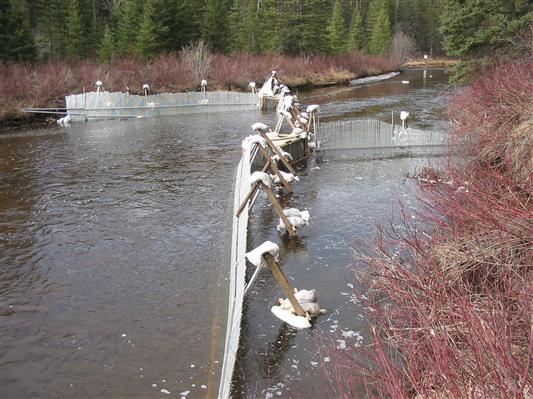
A fish counting fence
Fish Tissue Monitoring
Fish tissue is analyzed for chemicals in order to assess the suitability for human consumption and the implications for fish health. Samples of fish tissue (muscle) are collected from captured fish and sent to analytical laboratories for analysis of metal content and tainting compounds (organic molecules that affect the flavour of the fish). Concentrations of chemicals in the tissue are then compared to Health Canada, Indian and Northern Affairs Canada and the Alberta Sportfishing Regulation guidelines for human consumption and to concentration thresholds known to result in effects on fish health. Fish tissue monitoring is conducted on the Athabasca and Clearwater rivers during the fish inventory programs. Fish tissue analyses has also been conducted on several regional lakes throughout the RAMP focus study area:
- Gregoire Lake (2002, 2007, 2012)
- Lake Claire (2003)
- Christina Lake (2003)
- Winefred Lake (2004)
- Namur Lake (2007)
- Gardiner Lake (2008)
- Big Island Lake (2008)
- Jackson Lake (2009)
- Keith Lake (2010)
- Net Lake (2010)
- Brutus Lake (2010)
Fish Assemblage Monitoring
Fish assemblage monitoring is conducted to characterize the fish assemblage of a river on the basis of total abundance, species richness, diversity, and an assemblage tolerance index, in areas downstream of focal projects relative to fish assemblages upstream of focal projects. Fish habitat is also assessed for any potential change(s) over time that would influence the fish assemblage in a river.
For additional information on sampling and analytical methods used by the RAMP Fish Populations component, please refer to the relevant sections of the RAMP Technical Design and Rationale report and the annual RAMP technical reports (see Monitoring Results). For more general information on fish populations, visit the Aquatic Ecology module.